

before the appointment
your first curly haircut: length, shrinkage & what to ask
the cut, the curl, the diffuser. three things to discuss before “just a trim.”
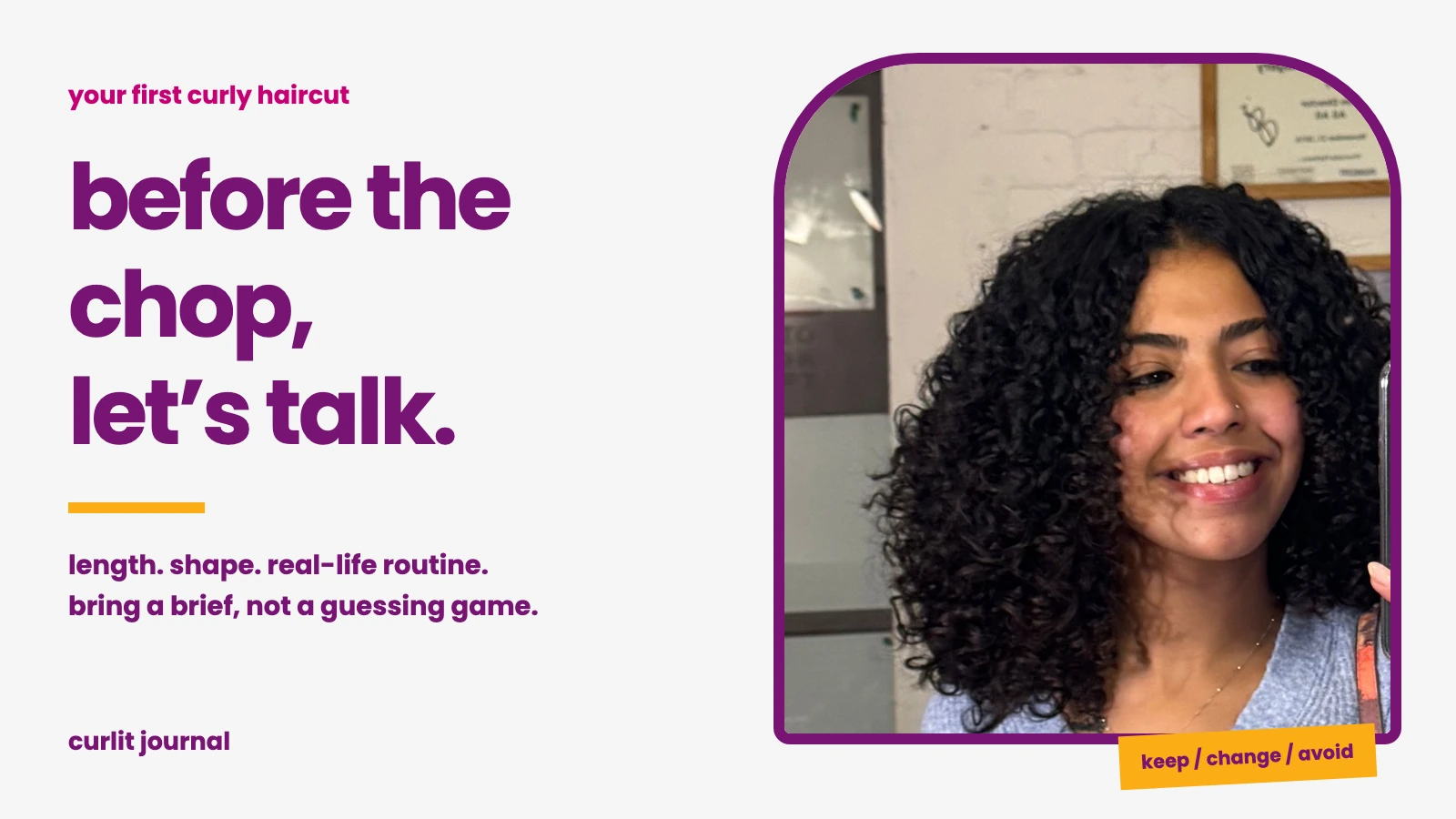
you asked for a trim. the mirror says “plot twist.” before blaming every missing-looking centimetre on the scissors, there are three things worth separating: the cut, the way your curls settle, and the styling.
here is how to plan a curly or wavy haircut around the hair you actually wear, with a consultation brief you can take into the chair.
the short version
agree on dry length, shape and finish
a cut removes length. curls and waves also take up length in their bends, and drying them in a more compact shape can make the finished hair look shorter again. agree on where the front, layers and longest ends should sit fully dry, in your usual style.
“just a trim” needs a little more paperwork. jump to the consultation brief if your appointment is already booked.
01 / the mirror moment
why can curly hair look much shorter after a cut?
the visible change is not always the same as the amount cut off. these three effects can overlap:
the cut
length has actually been removed. shorter front pieces or layers can change the outline even when the longest part still looks long.
the curl
a curved strand reaches a different point from the same strand stretched out. “shrinkage” describes that difference in how long it looks, not hair disappearing.
the finish
drying with curls gathered upward can create a more compact look than drying with them hanging down. extra lift at the roots can change the outline too.
so a wet or stretched “before” and a fully diffused “after” are not a fair length comparison. use your own fully dry, everyday hair as the starting point.
the useful question
“can you show me where this section is likely to sit dry, and what might change with the way we style it?”
no one can promise an exact shrinkage percentage for your whole head. do not use a fixed centimetre allowance as a haircut formula.
02 / set your own expectations
wavy hair does not owe you ringlets
loose waves, spirals and tighter curls have different shapes. your own head may have a mixture. plan around what your sections actually do, rather than expecting every section to match an inspiration photo.
- with waves: say whether you like a longer, looser finish or more lift and definition. do not assume shorter automatically means curlier.
- with curls: point out the sections that sit higher when dry, especially around the face. one length limit may not describe every layer.
- with mixed patterns: show the differences in your normal dry hair. ask how the proposed shape will work with them.
a haircut can change the outline; it is not a promise of someone else’s curl pattern. more visible shrinkage is not a score for how healthy your hair is.
03 / the dryer gets a vote
how does diffusing change the finished length?
the question is not only “did they use a diffuser?” ask how the hair was held while it dried.
hanging freely
hovering the diffuser around hair without gathering the ends into its bowl can give a more elongated finish.
cupped upward
supporting sections in the bowl, often called pixie diffusing, can encourage a more compact, defined finish. this can affect waves as well as curls.
root lift
head position and drying the roots with lift can change volume and the silhouette. a big salon finish may look different from your usual upright routine.
these are styling possibilities, not guaranteed outcomes. Curlsmith’s technique guide describes the first two approaches; stylist guidance from Associated Hair Professionals discusses head position and volume.
ask for a finish you can repeat. if you air-dry at home, say so before the cut. if you diffuse, ask the stylist to demonstrate the position and technique, not only name the product. a better comparison does not require higher heat.
04 / before you book
check the service, not just the word “curly”
- what is included? consultation, wash, styling, full drying and a final shape check, or only a cut? confirm time and total price.
- how should i arrive? ask for instructions for your exact service.
- wet, dry or both? ask why that method suits your usual styling, including straight styles if you wear them.
preparation varies. Ophelia Curls in Egypt requests washed, detangled, dry hair without mousse or gel for its dry cut. Curly Girls Studio in Canada describes a different styled arrival. follow your booking instructions; these examples are not salon endorsements.
Lazarou’s consultation guide covers wet, dry and combined approaches. whichever is proposed, ask how you will check the finished dry shape.
05 / take this into the chair
a haircut brief that makes the decision clearer
bring front, side and back photos of your own fully dry, everyday hair. for an inspiration photo, name the detail you like. then fill in these four decisions, in your phone notes or with your stylist.
1. my priority
if we cannot have everything, i care most about: ____.
i want to keep: ____. change: ____. avoid: ____.2. my limits
show where the longest ends, shortest face-framing pieces and shortest layers should sit when dry. my limit for each: ____.
i need to tie back: all / some / none of my hair.3. my real finish
i usually air-dry / hover diffuse / cup sections upward / use another method: ____.
hands-on styling time i will actually spend: ____.
i also wear my hair: ____.4. our agreement
please show the proposed change before cutting. if the shape needs more length removed than we agreed, check with me first.
we will review the fully dry front, sides and back before i leave.
point to the dry-length limits together. “shoulder length” on a stretched section leaves room for an expensive misunderstanding.
06 / what a useful brief sounds like
“more shape” becomes an actual conversation
example, not a haircut prescription
“keeping enough length for a low ponytail matters more to me than extra volume. i want some shape around my face, but i don’t want a fringe.”
“i usually air-dry. please show me the shortest front piece and layer you propose, and where they may sit dry. can we check the finish without styling it into a much tighter shape than i normally wear?”
“if that reference needs shorter layers than my limit, please show me the alternative before we start.”
that gives the stylist a priority, a practical constraint and a decision to discuss. “do whatever you think” can still be your choice; it does not have to be your default.
07 / the final check
check the cut and learn the finish
- look at the front, sides and back once fully dry. check the specific limits you agreed.
- ask how much of the look comes from the shape and how much from the styling.
- note the technique and product roles you can repeat with your routine.
- ask how to contact the salon if you have questions after washing at home.
if it looks shorter than expected, say so while you are there. discussing shrinkage does not excuse cutting past an agreed limit. equally, comparing wet hair with dry curls can hide what actually changed.
our Curlit take: a good consultation should leave you with a shared plan and a finish you understand. for a realistic drying-time brief, see why curly hair takes so long to dry.
your curls can be unpredictable. your brief can be specific.
how we put this together
we reviewed published salon preparation and practitioner styling guidance, then created this consultation tool. sources checked in October 2026. this is a planning guide, not a diagnosis, a salon ranking or a prediction of your result. the examples are written by Curlit; they are not customer testimonials.