

wash-day notes / curly hair
why does curly hair take so long to dry?
find the slow part, choose your drying method and give wash day a smaller role in your calendar.
the short answer
curly hair can take a long time to dry when there is a lot of water left to remove, the room is humid, or parts of your hair stay tucked together and get less airflow. start by checking what is still wet and how you are drying it. a long drying time alone does not tell you your hair’s porosity or prove you picked the wrong products.
washed. styled. made coffee. answered messages. somehow, the roots are still living their best underwater life.
the goal is a routine that fits your day. here is how to find the slow part without making wash day your second job.
01 / know your clock
first, which kind of “taking forever” do you mean?
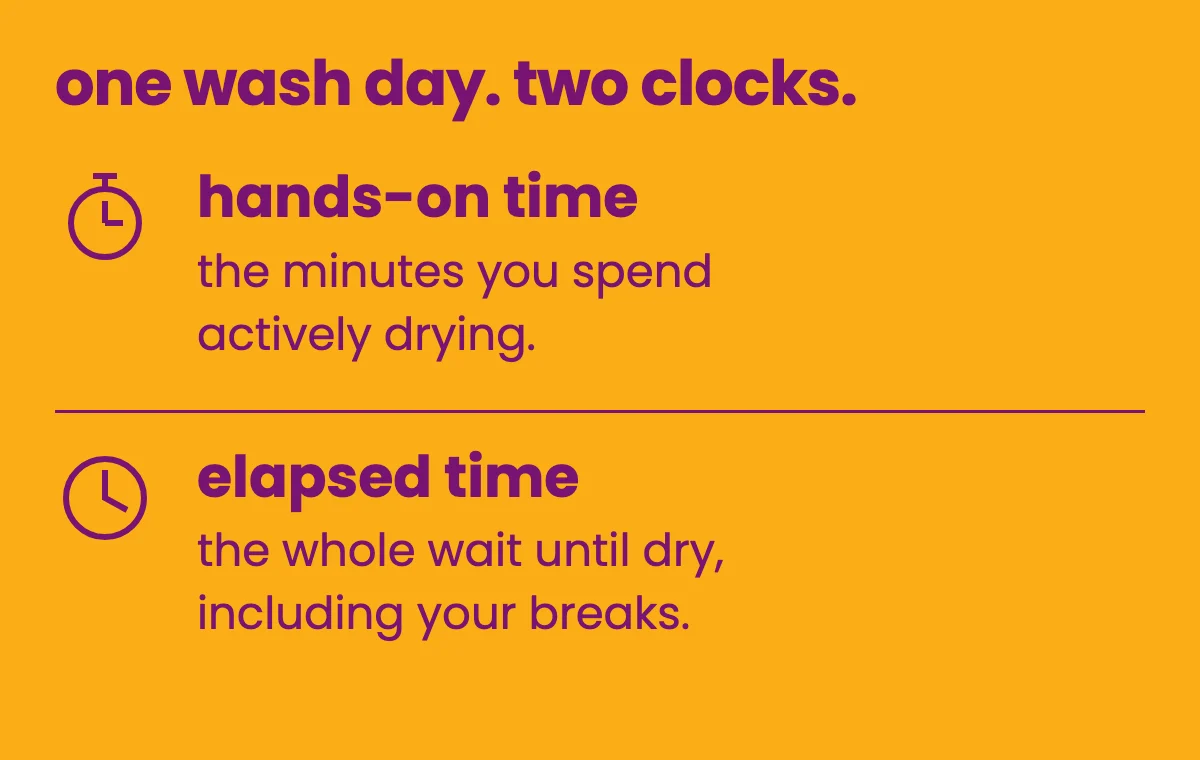
hands-on time is time you spend actively drying: holding a diffuser, moving between sections or gently blotting water. elapsed time runs from the end of styling until your roots and lengths feel dry, including the time you spend doing something else.
air-drying can involve very little work and a lot of waiting. diffusing asks for your attention while the dryer is on. a mix can fit somewhere between them. deciding which clock bothers you makes the next step much clearer.
02 / find the slow part
why is your curly hair still wet? check these four things
how much water are you starting with?
if your hair is still dripping after styling, some of the job is simply removing that extra water. try gently blotting with a soft towel or t-shirt, without rubbing or twisting your curls. the American Academy of Dermatology recommends gentle towel or t-shirt drying to absorb moisture.
if very wet styling works well for your definition, keep that preference in the picture. compare a gentle final blot on one wash day with your usual approach on another. watch both the drying time and the finish; speed is only useful if you like the result.
is it all your hair, or one stubborn patch?
check the roots, the underside and the inside of a thicker curl section separately. ends that feel dry do not tell you what is happening underneath. if you use a diffuser, notice whether you keep drying the easy-to-reach lengths while the same roots stay damp.
try changing your position so the remaining damp areas can receive airflow, following your dryer’s instructions. treat this as a practical check, not a reason to blast your scalp with hotter air. your roots do not need a disciplinary meeting.
are you drying in a steamy room?
humidity slows evaporation. the National Weather Service explains this relationship in its guidance on heat and humidity. applying that basic principle to your routine, a less steamy space is a sensible thing to try; it does not give us a number of minutes you will save.
note where you dry your hair. changing rooms after a shower is an easier first experiment than replacing every product on the shelf.
what changed since your usual wash day?
did you add another styling layer, use a different amount, start with wetter hair or change drying methods? write that down before blaming one ingredient. if several things changed together, timing alone cannot tell you which one made the difference.
if the question is about a sticky finish rather than actual wetness, our guide to styling gel feeling sticky tackles that separate problem. for a useful timing comparison, keep your products and amounts consistent while you test one drying change.
03 / pick your method
air-dry, diffuse or mix the two?
choose for the kind of day you are having. none of these earns a curly-girl gold star.
air-dry
hands-on effort: little active drying work
useful when you can leave drying time open; less control over when you finish.
diffuse
hands-on effort: active attention while using the dryer
useful when you want to direct airflow to damp areas; actual time depends on your hair, routine and appliance.
combine them
hands-on effort: a drying session plus waiting time
try air-drying for part of the process, then diffusing remaining damp areas. include both parts in your elapsed time.
if you diffuse, use low or medium heat and a heat-protectant product according to its directions, as advised by the American Academy of Dermatology. follow your appliance’s instructions for the attachment, handling and distance. choose a product labelled for heat protection; a styling product is not automatically a heat protectant.
04 / try it next wash day
make the next wash day a useful test
pick one change: a gentle final blot, a less humid room, or giving a missed damp section some attention. keep the other parts of your routine as similar as practical. record the result, then repeat before deciding it is your new rule. one unusually humid afternoon can make a very dramatic guest appearance.
copy these prompts into your notes. start elapsed timing when styling ends and stop when the areas you check feel dry; record styling time separately if you want to track the whole routine.
your wash-day log / copy into your notes
- date, room and drying method
- products, amounts and starting wetness
- one change you tested
- hands-on drying minutes
- styling ended / hair felt dry
- total elapsed drying time
- last area to dry / how you liked the finish
keep the change that helps your schedule and gives you a finish you enjoy. wash day is not a full-time job.
the rest of your routine deserves a plan too.
our hair quiz helps you choose a curlit routine for your hair.
take the hair quiz →